
ANGKOR
The Angkor Archaeo-logical Park is home to the magnificent temple ruins of Angkor, including the legendary Angkor Wat, Bayon and dozens of other ancient ruins of the, Angkorian-era Khmer Empire. The Angkor Park is a World Heritage site and encompasses more than 400 square kilometers just outside Siem Reap City in northwestern Cambodia.
Siem Reap City is the gateway to the Angkor Archaeological Park. There are no hotels within the Park grounds and most visitors stay in Siem Reap where almost all of the area's hotels and restaurants are located. Siem Reap City is just south of the Angkor Archaeological Park with the Park entrance located only 3km north of town. With the exception of the Roluos Group of temples 13km east of Siem Reap, the most important temple ruin are within 6-25km north of town, the closest major temple being Angkor Wat. To arrange your visit to the Angkor Archaeological Park you will need to decide how long to stay, purchase an admission pass, arrange transportation to the temples, obtain a guidebook or tour guide and plan out your temple itinerary.
Angkor Park: Getting Started
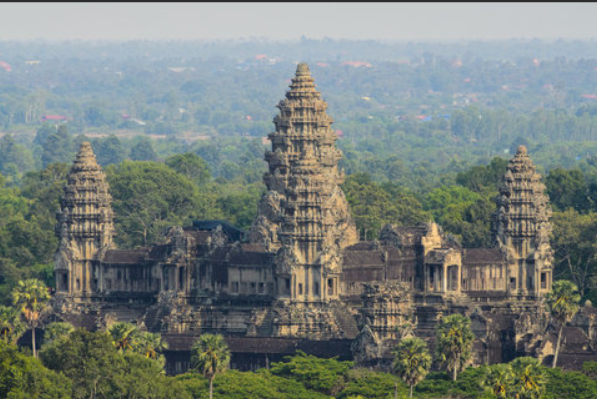
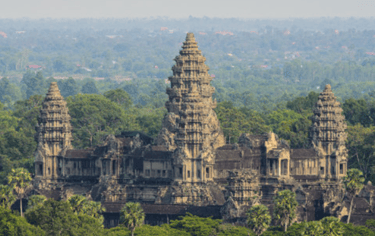
Angkor Archaeological Park
The temples ruins contained within the Park represent the remnants of the millennium-old capitals of the old Khmer Empire. The Khmer people were and are the dominant ethnic group in Cambodia. The name ‘Angkor’ refers both to the Angkorian-era Khmer Empire that stretched across much of mainland Southeast Asia between the 9th and 15th centuries A.D., and also refers to the capital city of the empire that was centered north of Siem Reap Cambodia.
Most of the temples within the Park were constructed between the 9th and 12th century A.D. and represent the pinnacle of ancient Khmer architecture, art and civilization. At its height, the Age of Angkor was a time wealth and power for the Khmer Empire. The capital city at Angkor was populated by more than a million people, Khmer kings constructed vast waterworks and grand temples and the Empire's military, economic and cultural dominance held sway over the area of modern Cambodia, as well as much of Thailand, southern Vietnam and Laos.
There are dozens of ruins within the Angkor Archaeological Park, others further afield. The temples vary in importance, interest and condition and are spread over a large area, often kilometers apart. In order to get the most of your visit, it is best to prepare a preliminary itinerary. Your itinerary should depend largely on the length of your visit and your level of interest, though some ruins are must-sees. Any itinerary should include the legendary Angkor Wat and Bayon. These two temples offer the most spectacular and unique examples of Angkorian art and architecture. On the road trip to Bayon, you will also see the South Gate and other minor ruins. As it is within walking distance of Bayon, even the briefest visit can usually include central Angkor Thom with its artistically interesting terraces and massive ‘temple-mountains,’ Baphuon and Phimeanakas.
As time and interest allows, build the rest of your itinerary around visiting each type of major ruin – temple mountains such as Pre Rup, Ta Keo, Bakong and West Mebon; flat, sprawling monastic complexes such as Ta Prohm, Preah Khan and Banteay Kdei; and unique monuments such as Neak Pean and Srah Srang. The Roluos Group, which is comprised the monuments of an early Khmer capital, lies about 13 km west of Siem Reap. It is a bit out of the way, but offers some fine examples of early Angkorian art and should be included in two or three day itineraries. Of special note is the artistically exquisite but more even distant temple, Banteay Srey. If there is any way of squeezing it into your itinerary, it is well worth it.
Admission and How Long to Stay
You must possess an admission pass (an 'Angkor Pass') to visit the temples and sites in the Angkor Archaeological Park. Passes may be purchased at the main entrance on the road to Angkor Wat. One-day tickets only can be purchased at the secondary tollgate on airport road entrance near Angkor Wat and at Banteay Srey.
Passes are sold in one-day ($37), three-day ($62) and seven-day ($72) blocks. The three day pass is valid for one week, i.e. 3 days to be used within the week, not necessarily consecutively. The seven day pass is valid for one month, i.e. 7 days to be used within the month, not necessarily consecutively.
A one-day visit allows you to see the highlights of the most famous temples but very little more. Three days is sufficient to visit all of the major temples once, a few of the minor ones and have a little extra time at your favorites. Seven days is enough time to really explore some of your favorite ruins and visit many of the minor structures as well. One passport-sized photo is require at time of purchase of three and seven day passes. If you do not have a photo, free photos are provided at the main entrance, though this can be a time consuming process at peak entrance hours.
Visiting hours are 5:00AM - 6:00PM. Angkor Wat closes at 6:00PM, Banteay Srey closes at 5:00PM and Kbal Spean at 3:00PM. Always carry your ticket. It will be checked upon each park entry and at major temples. There is a significant fine for not possessing a valid ticket inside the park. A regular admission ticket is not required to visit Phnom Kulen, Koh Ker or Beng Melea, but there is a separate entrance fee of $20, $10 and $5, respectively.
There are dozens of temple ruins in the Angkor Archaeological Park spread across more than 400 square km. all in different states of ruin and displaying a range of artistic and architectural styles. To get the most from your limited time at the Park you will need to plan a temple itinerary. Your personal temple itinerary depends largely on how much time you have and your level of interest, though some temples are ‘must sees.’ See the suggested itineraries page for much more.
What to Bring
Wear light, airy, covering clothing to protect yourself from the sun and mosquitoes. The sun can be intense so bring a hat, sunglasses and perhaps sunscreen. Consider buying a traditional Khmer scarf (krama) to keep the sun off your neck. Carry a raincoat during the wet season, though you will probably only need it in the afternoon. You should have mosquito repellent for sunrise and sunset hours. Wear practical shoes for climbing narrow steps and walking on uneven surfaces. For serious temple explorers, a flashlight, notebook and compass can come in handy. Books, refreshments, trinkets, postcards and film are available from small vendors throughout the temple complex.
Transportation to and around the Temples
The temples are too far apart to make foot travel practical (though some hearty visitors are hiking it anyway). Transportation options include: two-person tuk-tuks (moto-romauk) average $10-$15/day; car taxis $20-$30/day; motorcycle taxi (motodup) for $8-$10/day; bicycles for $2-$3/day.
To avoid misunderstandings, negotiate the details of the driver’s services carefully - exact price, what time you expect the day to begin and end, availability during lunch and evening hours, limitations on your itinerary, different prices for small/large circuits, etc.
There are always additional fees for transport to distant temples off the main circuits (e.g. Banteay Srey, Phnom Kulen, Kbal Spean, Koh Ker) Negotiate the fare with your driver. Bicycling around the temples has become quite popular. If you have the time to spare, the roads are good, the terrain is flat and the distances are about right..
Moto-remorques (tuk-tuks)
Moto-romorques (a.k.a. 'tuk-tuk') are the most common and popular form of transportation in town - the semi-enclosed trailer offering a comparatively pleasant ride. Tuk-tuks are omnipresent in Siem Reap. Just step to the curb and they will find you. For short trips around town, foreigners are expected to pay 3000R-US$3. Bargain! Full day rates for transportation to the temples: $10-$15/day. Additional charge for transport to distant temples.
Car Taxis
Private car taxis offer a comfortably air-conditioned way to tour the temples, though they are the most expensive option. Rates: $20-$30 per day plus additional charges for transportation to distant temples off the main circuits. Taxis from the airport to town also offer taxi/tour services to the temples.
Angkor Temple Guides
Experienced guide and driver. One-day trips to Preah Vihear, with or without guide.Charles De Gaulle Blvd, Siem Reap, Cambodia.
Tel: +(855)(0)12-788354
info@angkor-temple-guides.com
www.angkor-temple-guides.com
Cambodia in Comfort
Vans, cars, with driver
Tel: +(855)(0)97-7583336
www.cambodiaincomfort.com
Larryta Express
Car and bus rental.
PP: #99, Sisowath Quay, Phnom Penh, Cambodia.
Tel: 011-202020
SR: #752, Route #6, Siem Reap, Cambodia.
Tel: +(855)(0)66-202020
www.larryta.com
Siem Reap Shuttle
Professionally chauffeured vehicles, Camry, Mercedes, Lexus, Jeep. Tours and packages. Temple, city, cultural.
Sivutha Blvd, Siem Reap, Cambodia.
Tel: +(855)(0)92-555518
+(855)(0)63-212121
Siem Reap Taxi Driver
Licensed local taxi driver and guides. English spoken. All sorts of transportation.
Tel: +(855)(0)12-941715
+(855)(0)97-5555563
www.siemreaptransport.com
Motorcycle Taxis
Motodups are motorcycles on which the passenger rides pillion. Though motodups are the least expensive motorized option, these days two-person ‘tuk-tuks’ (moto-romorks) are the most popular. Bargain! Motodups should be a bit more than half as expensive as tuk-tuks. Additional charge for transport to distant temples. Full day rates for transportation to the temples: $8-$12/day
Helicopter Charter and Rides
Helistar Cambodia
Helistar Cambodia offers scenic helicopter tours of the temples beginning at US$100/person for an 8 minute jaunt around Angkor Wat. It isn't a particularly cheap way to tour but the view is spectacular and memorable. Helistar Cambodia offers specialized tours, aerial photography and charter services. Multiple aircraft in service. Located at Siem Reap International Airport, Domestic Terminal.
Office on National Route #6 (Airport Road), Borey Angkor Arcade, diagonally opposite the Total station, about 1 kilometer west of town center. Walk-in customers welcome.
Tel: +(855)(0)63-966072
+(855)(0)12-449555
www.helistarcambodia.com
Helicopters Cambodia
Operating in Cambodia since 1998 with highly trained internationally licenced pilots. Helicopters Cambodia provides charter flights to all areas of Cambodia. For those wanting to avoid the crowds and experience the temples from another perspective this is truely a unique experience.
Tel: 063-963316, 012-814500
MyFly
MyFly “We are proud to present you an exciting adventure in the air above Siem Reap, Cambodia. You will fly a 2-seat light airplane around the most beautiful temples of Cambodia, see a floating village and ancient Hariharalaya, old capital of Kambuja Desa, picturesque rice fields and the Tonle Sap lake. Our simple set of rules makes our flights absolutely safe for you; all airplanes, passengers and third parties are covered by insurance.”
Tel: 068-704601
Located off at the Jayavarman Airfield, just off National Route #6 east of town
Bicycle Rental
Bicycling have become a popular way to visit the temples. The roads between the main temples are paved and the distances are about right for a bicycle touring. Many of the hotels have bicycles for rent. $1-$4/day depending on the type and quality of the bike.
Green Cycles Travel
Scheduled and custom bicycle tours. Bike rental.
Old Market area, Siem Reap, Cambodia.
Tel: +(855)(0)12-783377
Green e-bike
Electric bike rental.
Open 7:30AM-7:00PM
Center Market, Siem Reap, Cambodia.
Tel: +(855)(0)95-700130
+(855)(0)95-700140
www.greene-bike.com
Motorcycle Rental
Tourists are no longer allowed to rent motorcycles or cars, or drive a vehicle in Siem Reap.
And other ways of getting around the temples...
Elephant Rides
During the day, elephants await customers near Bayon and at the South Gate of Angkor Thom and they offer rides between those two points. $10 - $15 for a 20 - 30 minute ride. In the evenings the elephants move from Bayon and are stationed at the base of Phnom Bakheng, ready to transport passengers up the hill for sunset ($15 for the ride up and, if you chose to ride down instead of walk, $10 for the ride down.)
Balloon Rides
Take a tethered helium balloon ride 200 meters straight up for an amazing aerial view of Angkor Wat, Phnom Bakheng, West Baray and the surrounding countryside. Bring a camera and binoculars if you have them. The big, yellow balloon is based about 1 kilometer west from Angkor Wat on the road from the airport to Angkor Wat.
Tour Guides
Whether you use a guidebook or hire a tour guide, it is essential to have some sort of guide lest the temples become just so many impressive piles of rocks. Tour guides are particularly helpful in explaining the bas-reliefs and history of the temples. Tour guides can be hired through most hotels and travel agents. Most guides ask $20 - $25/day.
You can either hire a tour guide and transport separately (usually through your guesthouse or a travel agent) or book a group tour through a travel agent in town such as Asian Value Travel. Group tours remove many of the hassles, and depending on your requirements, cost about the same or less than doing it yourself, especially for the lone traveler. On the other hand, you do lose some freedom and a bit of the adventurous atmosphere of Angkor. Some places focus on specialty tours such as distant temple, Tonle Sap and photographer’s tours by Peace of Angkor Tours and dirt bike/4WD adventure and cultural tours by Hidden Cambodia Adventure Tours.
Angkor Temple Guides
San Park is an experienced tour guide and reliable driver, specializing in Angkor. very reasonably priced. Oneday trips to Preah Vihear, with or without guide.
Charles De Gaulle Blvd, Siem Reap, Cambodia.
Tel: +(855)(0)12-788354
Angkor Thom and TransportationTransportation, multi-lingual tour guide, tour packages, city tour and daily tour at reasonable rates.
Tel: +(855)(0)92-890005
www.angkorthomservices.com
Angkor Tour Guide Service
Angkor park tour packages and tour guides (English Mandarin, French Japanese), transportation (car, mini-van, transport to distant temples,) hotel reservations.
Siem Reap, Cambodia.
Tel: +(855)(0)12-631052
+(855)(0)97-7631052
sokchea@guideangkor.com
www.guideangkor.com
Guides books
Guidebooks and other Angkor related books can be purchase at bookstores and many of the souvenir shops. Bootlegged books are sold at the Old Market and by vendors throughout the Angkor complex.
Ancient Angkor by Michael Freeman and Claude Jacques. (Thailand: River Books, 2006) Beautifully photographed, authoritative guidebook to the temples of Angkor and the Angkor Archaeological Park. One of the top guidebooks to the temples. Recommended.
Angkor: Cambodia’s Wondrous Khmer Temples by Dawn F. Rooney (Odyssey Publications, Hong Kong, 2006, 5th edition) Popular, complete, accurate. The most complete English language guidebook available. One of the top guidebooks to the temples. Recommended.
The Monuments of the Angkor Group (Les monuments du groupe d'Angkor) by Maurice Glaize. Classic 1944 guide to the temples written by a former Conservator of Angkor (1937-1945). Available in English and French and also online.
Angkor Observed by awn F. Rooney. (Thailand: Orchid Guides, 2003) A nostalgic picture of the early days of tourism to Angkor drawn through excerpts from 19th/20th century journals and travelogues.
A Field Guide to Siem Reap Pagodas by Ray Zepp. (Cambodia: 2000) A knowledgeable, easy-to-read introduction to Cambodian Buddhism and local pagodas.
The Customs of Cambodia by Zhou Daguan (Chuo Ta-Kuan). A short but unique and fascinating eye-witness account of royal and ordinary life in 13th century Angkor.
A History of Cambodia by David Chandler. (Bangkok Thailand: White Lotus, 1994) A complete, scholarly but accessible account of Cambodian history from the dawn of Funan to the present.
Images of the Gods: Khmer Mythology in Cambodia, Laos & Thailand by Vittorio Roveda. (Bangkok: River Books, 2005) A sweeping photographic exposition and historical analysis of ancient Khmer sculpture reliefs from Angkor and across the region.
Khmer Heritage in the Old Siamese Provinces of Cambodia by Etienne Aymonier. (Bangkok Thailand: White Lotus, 1999, orig. 1901) Turn of the century report/guide. Locations and temple descriptions of familiar and remote temples.
Travels in Siam, Cambodia, Laos and Annam by Henri Mouhot. (Thailand: White Lotus, 2000 reprint, orig. 1864).
Ak Yum
Description: Very early ruins
Location: AAP – Near the West Baray
Date: 8th–11th century AD
Angkor Thom
Description: The walled city of Jayavarman VII
Location: AAP
Date: 12th–13th century AD
King/Patron: Jayavarman VII
Style: Bayon
Angkor Wat
Description: The centerpiece of Angkor
Location: AAP – 6 km north of Siem Reap
Date: Early–Mid 12th century AD
King/Patron: Suryavarman II
Style: Angkor Wat
Bakong
Description: Largest temple in the Roluos Group
Location: AAP – Roluos Group
Date: Early 9th century AD
King/Patron: Indravarman I
Style: Preah Ko
Baksei Chamkrong
Description: Temple pyramid near the South Gate of Angkor Thom
Location: AAP/PC – Near South Gate
Date: Mid 10th century AD
King/Patron: Harshavarman I
Style: Bakheng
Banteay Kdei
Description: Monastic complex
Location: AAP/GC
Date: Late 12th – Early 13th century AD
King/Patron: Jayavarman VII
Style: Angkor Wat / Bayon
Banteay Prei
Location: AAP/GC
Date: Late 12th – Early 13th century AD
King/Patron: Jayavarman VII
Style: Bayon
Banteay Samre
Description: Angkor Wat–style; fewer tourists
Location: AAP – 4 km east of East Mebon
Date: Mid 12th century AD
King/Patron: Suryavarman II
Style: Angkor Wat
Banteay Srey
Description: “Citadel of Women”; finest carvings
Location: 37 km north of Siem Reap
Date: Late 10th century AD
King/Patron: Rajendravarman
Style: Banteay Srey
Baphuon
Description: Newly restored; reclining Buddha on west
Location: AAP/PC – Central Angkor Thom
Date: Mid 11th century AD
King/Patron: Udayadityavarman II
Style: Baphuon
Bat Chum
Description: Three well-preserved prasats
Location: AAP/PC
Date: Mid 10th century AD
King/Patron: Rajendravarman
Style: Pre Rup
Bayon
Description: Temple of Faces
Location: AAP/PC – Central Angkor Thom
Date: Late 12th century AD
King/Patron: Jayavarman VII
Style: Bayon
Beng Melea
Description: Jungle temple
Date: Early 11th century AD
King/Patron: Suryavarman II
Style: Angkor Wat
Chapel of the Hospital
Description: One of 100+ Angkorian hospitals
Location: AAP/PC
Date: Late 12th century AD
King/Patron: Jayavarman VII
Style: Bayon
Chau Say Tevoda
Description: Newly restored
Location: AAP/PC
Date: Early 12th century AD
King/Patron: Suryavarman II
Style: Angkor Wat
East Mebon
Description: Temple mountain
Location: AAP/GC
Date: Late 10th century AD
King/Patron: Rajendravarman II
Style: Pre Rup
Kbal Spean
Description: Riverbed carvings
Location: 49 km north of Siem Reap
Date: 11th–13th century AD
Kleangs (North & South)
Description: “Royal Storehouse”
Location: AAP/PC – Central Angkor Thom
Date: Late 10th – Early 11th century AD
King/Patron: Jayavarman V
Style: Khleang
Krol Ko
Location: AAP/GC
Date: Late 12th century AD
King/Patron: Jayavarman VII
Style: Bayon
Krol Romeas
Description: Mostly just a wall
Location: AAP/GC
Kutisvara
Description: Very early ruin
Location: AAP/GC
Date: 9th–10th century AD
King/Patron: Jayavarman II
Style: Preah Ko
Lolei
Description: Brick prasats; active pagoda
Location: AAP – Roluos Group
Date: Late 9th century AD
King/Patron: Yasovarman I
Style: Pre Rup / Bakheng
Neak Pean
Description: Iconic water temple
Location: AAP/GC
Date: Late 12th century AD
King/Patron: Jayavarman VII
Style: Bayon
Phimeanakas
Description: Scalable pyramid
Location: AAP/PC – Central Angkor Thom
Date: Late 10th – Early 11th century AD
King/Patron: Jayavarman V
Style: Khleang
Phnom Bakheng
Description: Sunset hill; very crowded
Location: AAP/PC – Near South Gate
Date: Late 9th – Early 10th century AD
King/Patron: Yasovarman I
Style: Bakheng
Phnom Krom
Description: Hilltop prasats with Tonle Sap view
Location: 15 km south of Siem Reap
Date: Late 9th – Early 10th century AD
King/Patron: Yasovarman I
Style: Bakheng
Phnom Kulen
Description: Where Angkor began
Location: 50 km north of Siem Reap
Date: 9th century AD
King/Patron: Jayavarman II
Style: Kulen
Prasat Bei
Location: AAP/PC – Near South Gate
Date: 10th century AD
King/Patron: Yasovarman I
Style: Bakheng
Prasat Kravan
Description: Interior brick bas-reliefs
Location: AAP/PC
Date: Early 10th century AD
King/Patron: Harshavarman I
Style: Pre Rup
Prasat Prei
Location: AAP/GC
Date: Late 12th – Early 13th century AD
King/Patron: Jayavarman VII
Style: Bayon
Prasat Suor Prat
Description: Line of 12 towers
Location: AAP/PC – Central Angkor Thom
Date: Early 13th century AD
King/Patron: Indravarman II
Style: Post-Bayon
Prasat Top (East)
Description: “Mangalartha”; last Brahmanistic structure
Location: Angkor Thom
Date: Late 13th century AD
King/Patron: Jayavarman VII
Style: Bayon
Prasat Top (West)
Location: Angkor Thom
Date: 9th–17th century AD
Style: Post-Bayon
Pre Rup
Description: Temple mountain; good carvings
Location: AAP/GC
Date: Late 10th century AD
King/Patron: Rajendravarman II
Style: Pre Rup
Preah Khan
Description: Large monastic complex
Location: AAP/GC
Date: Late 12th century AD
King/Patron: Jayavarman VII
Style: Bayon
Preah Ko
Description: Temple of the Sacred Cow
Location: AAP – Roluos Group
Date: Late 9th century AD
King/Patron: Indravarman I
Style: Preah Ko
Preah Palilay
Description: Tower with good gopura carvings
Location: AAP/PC – Central Angkor Thom
Date: Late 12th – Early 13th century AD
King/Patron: Jayavarman VII
Style: Bayon
Preah Pithu Group
Description: Uncrowded Hindu/Buddhist group
Location: AAP/PC – Near Terrace of Elephants
Date: Early 12th century AD
King/Patron: Suryavarman II
Roluos Group
Description: First Angkorian capital (Bakong, Preah Ko, Lolei)
Location: AAP – Roluos
Date: Late 9th century AD
Spean Thma
Description: Shows ancient river course changes
Location: AAP/PC
Srah Srang
Description: Royal baray; sunrise spot
Location: AAP/PC
Date: Mid 10th & Late 12th century AD
King/Patron: Jayavarman VII
Style: Bayon
Ta Keo
Description: Massive, plain temple mountain
Location: AAP/PC
Date: Late 10th – Early 11th century AD
King/Patron: Jayavarman V
Style: Khleang
Ta Nei
Description: Quiet jungle location
Location: AAP
Date: Mid 12th century AD
King/Patron: Jayavarman VII
Style: Bayon
Ta Prohm
Description: Iconic jungle temple
Location: AAP/PC
Date: Mid 12th – Early 13th century AD
King/Patron: Jayavarman VII
Style: Bayon
Ta Prohm Kel
Description: Small hospital shrine
Location: AAP/PC – Opposite Angkor Wat
Date: Late 12th century AD
King/Patron: Jayavarman VII
Style: Bayon
Ta Som
Description: Mini Ta Prohm; photogenic face tower
Location: AAP/GC
Date: Late 12th century AD
King/Patron: Jayavarman VII
Style: Bayon
Tep Pranam
Location: AAP/PC – Central Angkor Thom
Date: 9th century AD
King/Patron: Jayavarman VII (later additions)
Style: Bayon
Terrace of the Elephants
Description: Elephant & garuda carvings
Location: AAP/PC – Central Angkor Thom
Date: Late 12th century AD
King/Patron: Jayavarman VII
Style: Bayon
Terrace of the Leper King
Description: Deep, detailed carvings
Location: AAP/PC – Central Angkor Thom
Date: Late 12th century AD
King/Patron: Jayavarman VII
Style: Bayon
Thma Bay Kaek
Location: AAP/PC
Date: Late 11th – Early 12th century AD
King/Patron: Suryavarman II
Style: Angkor Wat
Thommanon
Description: Beautiful color-changing stone; photogenic
Location: AAP/PC
Date: Late 11th – Early 12th century AD
King/Patron: Suryavarman II
Style: Angkor Wat
Wat Athvea
Description: Angkor Wat–style countryside temple
Location: 8 km south of Siem Reap
Date: Late 11th century AD
King/Patron: Suryavarman II
Style: Angkor Wat
West Mebon
Description: Island temple ruins
Location: AAP – Island in West Baray
Date: Late 11th century AD
King/Patron: Udayadityavarman II
Style: Baphuon
Temples of Kampong Thom Province
Phum Prasat
Location: Kampong Thom
Date: 7th century AD
King/Patron: Suryavarman I
Prasat Andet
Location: Kampong Thom
Date: 6th–7th century AD
Prasat Kuhak Nokor
Description: Peaceful setting
Location: Kampong Thom
Date: 11th century AD
Prasat Poo-Wee-Ung
Location: Kampong Thom
Date: 7th century AD
Prasat Preah Te-it
Description: “Leaning Tower of Kampong Thom”
Location: Kampong Thom
Date: Pre-Angkorian
Sambor Prei Kuk
Description: Large, important temple complex
Location: Kampong Thom
Date: 7th century AD
King/Patron: Isanavarman I
Temples of Takeo Province
The temple ruins in Takeo Province are located south of Phnom Penh and can be visited in a day trip. These pre-Angkorian and Angkorian sites are historically significant. Most can be reached by bus from Phnom Penh’s Central Market along National Routes.
Angkor Borei
• Location: Takeo Province
• Date of Construction: Neolithic – 15th century AD
Phnom Chisor
• Location: Takeo Province, just off Route #2
• Date: 10th–11th century AD
• King/Patron: Suryavarman I
Phnom Da
• Location: Takeo Province
• Date: Mid-11th century AD
• King/Patron: Rudravarman
Prasat Neang Khmau
• Location: Takeo Province, just off Route #2
• Date: 10th century AD
• King/Patron: Jayavarman IV
Ta Prohm at Tonle Bati
• Location: Takeo Province, Tonle Bati resort area
• Date: 12th century AD
• King/Patron: Jayavarman VII
Yeah Peau
• Location: Takeo Province, Tonle Bati resort area
• Date: 12th century AD
• King/Patron: Jayavarman VII
Temples of Preah Vihear Province
Preah Vihear Province borders Siem Reap to the northwest and contains major Angkorian-era ruins. Koh Ker was once a rival capital city, and Preah Vihear Temple sits dramatically on a cliff near the Thai border.
Koh Ker
• Description: Large, archaeologically important temple complex
• Location: Preah Vihear Province, about 1.5 hours from Siem Reap
• Date: 10th century AD
• King/Patron: Jayavarman IV
Preah Khan at Kampong Svay (Bakan)
• Location: Preah Vihear Province
• Date: 11th – late 12th century
• King/Patron: Suryavarman I & II, Jayavarman VII
Preah Vihear
• Description: Unique ruins with spectacular views over the Cambodian plain
• Location: Preah Vihear Province, near the Thai border
• Date: Late 9th – mid-12th centuries
• King/Patron: Yasovarman I and Suryavarman I & II
Temples of Kampot Province
Phnom Chhnork
• Description: Pre-Angkorian temple ruin located inside a cave
• Location: East of Kampot town, between Kampot and Kep
• Date: 7th century AD
Glossary
Anastylosis – Archaeological rebuilding technique where structures are dismantled and reconstructed.
Angkor – Capital of the Khmer Empire (9th–12th centuries) and the empire itself.
Apsara – Mythological celestial nymph; Devatas are similar standing female divinities.
Banteay – Means “fortress” or “citadel”; often a monastic temple complex.
Baray – Large man-made water reservoir built by Angkorian kings.
Boeung – Means “lake”.
Champa – Indianised kingdom located in present-day south-central Vietnam.
Corbel Arch – False arch formed by projecting stones in tiers.
Gopura – Gateway or entrance tower of a temple complex.
Khmer – Major ethnic group and language of Cambodia.
Angkor Temple Guide
Temples of Angkor Archaeological Park (AAP)
(Plus Grand Circuit – GC, Petit Circuit – PC, Roluos Group, and Outlying Site)
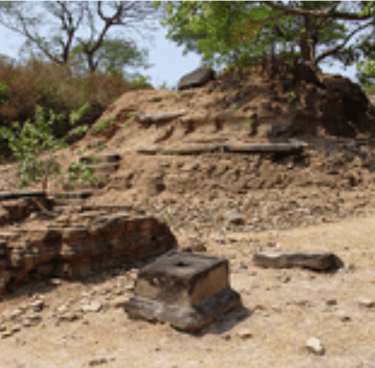
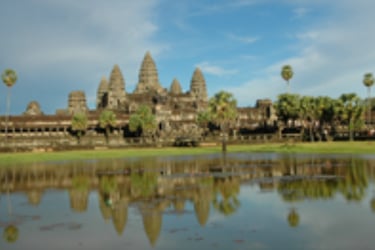
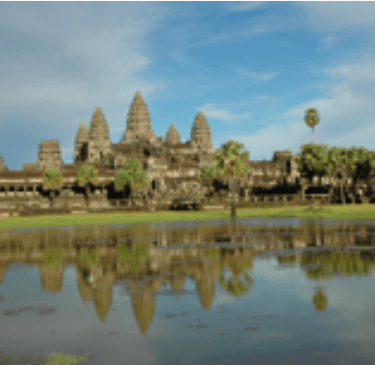
There are dozens of temple ruins in the Siem Reap area. Your temple itinerary depends largely on how much time you have and your level of interest, though some temples are ‘must sees.’
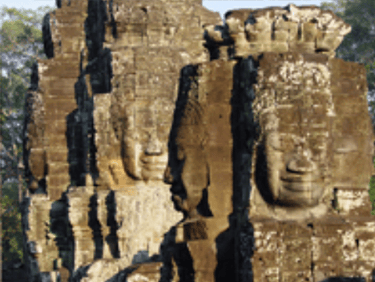
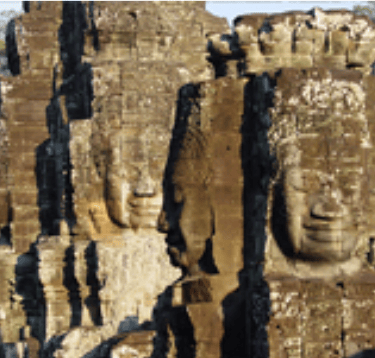
Any itinerary should include the legendary ruins of Angkor Wat and the giant faces of Bayon. These two temple ruins offer the most spectacular and unique examples of Angkorian art and architecture. On the road trip to Bayon, you will also see the South Gate of Angkor Thom and some other minor ruins. As it is within walking distance of Bayon, most itineraries can easily include central Angkor Thom, with its artistically interesting terraces and massive ‘temple-mountains,’ Baphuon and Phimeanakas. Due to lighting conditions, it is best to visit Angkor Wat in the afternoon, so most itineraries begin in the morning with the South Gate of Angkor Thom and Bayon.
As your schedule allows, build the rest of your itinerary around visiting each type of major ruin – temple mountains such as Pre Rup, Ta Keo, Bakong and West Mebon; flat, sprawling monastic complexes such as Ta Prohm, Preah Khan and Banteay Kdei; and unique monuments such as Neak Pean and Srah Srang.
The Roluos Group, which comprises the monuments of an early Khmer capital, lies 12 km west of Siem Reap, outside the main temple complex. It is a bit out of the way, but offers some fine examples of early Angkorian art and should be included in two or three day itineraries.
Of special note is the artistically exquisite but more distant temple, Banteay Srey. If there is any way of squeezing it into your itinerary, it is well worth it.
Suggested Itineraries
Half-Day Visit
1) South Gate of Angkor Thom
2) Central Angkor Thom (Bayon, Terrace of the Elephants, Terrace of the Leper King)
3) Ta Prohm
4) Angkor Wat
One or Two Day Visit
Day 1
Morning:
1) South Gate of Angkor Thom
2) Central Angkor Thom (Bayon, Phimeanakas, Terrace of the Elephants, Terrace of the Leper King).
(Single day visitors: Old Market area/souvenir shops in Siem Reap at lunch.)
Afternoon:
4) Ta Prohm
5) Pre Rup (optional)
6) Angkor Wat
7) Phnom Bakheng for sunset (Phnom Bakheng, long the favored sunset location for its view of the lake and Angkor Wat, in recent years has become wildly over-touristed. In an effort to protect the temple, visitor numbers at sunset are now sometimes restricted and both authorities and Heritage Organizations recommend alternative sunset spots to try to take some pressure of Phnom Bakheng.
Day 2 Options
Option A: Banteay Srey
Morning:
1) Angkor Wat for sunrise
2) Pre Rup
3) Banteay Srey
4) Banteay Samre (optional)
5) Thommanon
Old Market area/souvenir shops in Siem Reap at lunch.
Afternoon:
6) Roluos Group (Bakong, Preah Ko, Lolei)
Option B: Variety of temples
Morning:
1) Angkor Wat for sunrise
2) Preah Kahn
3) Victory Gate
4) Thommanon
5) Pre Rup (optional)
6) Prasat Kravan
Old Market area/souvenir shops in Siem Reap at lunch.
Afternoon:
7) Roluos Group (Bakong, Preah Ko, Lolei)
Option C: Grand circuit
Morning:
1) Angkor Wat for sunrise
2) Preah Kahn
3) Neak Pean
4) Ta Som
5) Pre Rup (optional)
6) Prasat Kravan (optional)
Old Market area/souvenir shops in Siem Reap at lunch.
Afternoon:
Roluos Group (Bakong, Preah Ko, Lolei)
Three Day Visit
Day 1
Morning:
1) South Gate of Angkor Thom
2) Central Angkor Thom (Bayon, Baphuon, Phimeanakas, Terrace of the Elephants, Terrace of the Leper King).
Lunch at restaurant near Angkor Wat
Afternoon
3) Victory Gate
4) Thommanon
5) Ta Keo (short visit)
6) Ta Prohm
7) Sunset at Angkor Wat
Traditional dance show in evening
Day 2
Morning:
1) Sunrise at Angkor Wat
2) Baksei Chamkrong, Prasat Bei, Thma Bay Kaek
3) Preah Kahn
4) Neak Pean
5) Ta Som
6) Pre Rup
Visit to Old Market area in Siem Reap at lunch.
Afternoon:
7) Roluos Group (Bakong, Preah Ko, Lolei)
8) Sunset at Phnom Bakheng
Day 3
Morning:
1) Banteay Srey
2) Banteay Samre
3) East Mebon
Visit to craft/silk workshop after lunch
Afternoon:
4) Prasat Kravan
5) Banteay Kdei
6) Srah Srang (optional)
7) Sunset at Angkor Wat
Of Special Interest:
Sunrise: Angkor Wat, (alternative: Srah Srang)
Sunset: Phnom Bakheng, Angkor Wat
Trees growing from temple ruins: Ta Prohm, Banteay Kdei, Ta Som
Giant carvings of faces: Bayon, the gates of Angkor Thom, Banteay Kdei, Ta Prohm and Preah Kahn
Notable artistry/carvings: Angkor Wat, Banteay Srey, Bayon, Bakong, Terrace of the Leper King
Suggested Itinenaries
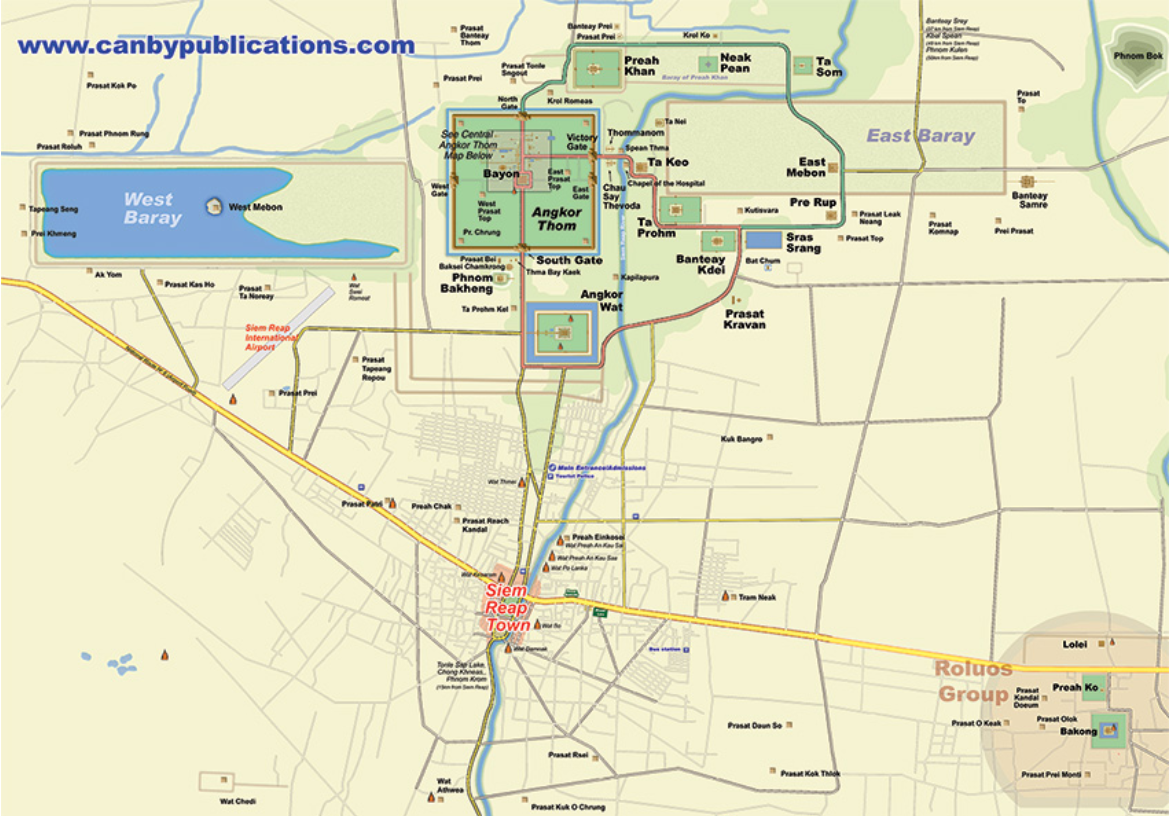
Angkor Temple Guide Suggestions
Angkor Thom: A Short Historical Guide (Cambodia: Apsara Authority, 2001)
Aymonier, Etienne. Khmer Heritage in the Old Siamese Provinces of Cambodia (Bangkok Thailand: White Lotus, 1999 reprint, orig. 1901)Turn of the century report/guide. Locations and temple descriptions of familiar and remote temples in Cambodia. Aymonier books are primarily of historical interest. Though for those interested in searching for and exploring some of Cambodia's more remote and obscure temples, Aymonier works can be a rich source of information.
Aymonier, Etienne. Khmer Heritage in Thailand (Thailand: White Lotus, 1999 reprint, orig. 1901) Turn of the century report/guide. Locations and temple descriptions of familiar and remote temples in Cambodia. Aymonier books are primarily of historical interest.
Booth, Andrew The Angkor Guidebook: Your Essential Companion to the Temples (Thailand: 2014, Amarin Printing and Publishing) Unique guidebook to the temple of Angkor Archaeological Park, employing photo overlays to show how the temples may have appeared when they were new and active.
Freeman, Michael and Jacques, Claude. Ancient Angkor (Thailand: River Books, 1999) Popular, beautifully photographed guidebook to the Angkorian temple in the Angkor Archaeological Park and some of the outlying temples.
Freeman, Michael. Phimai (Thailand: River Books Guides, 1997) Guide to the Angkorian-era ruin of Pimai in Thailand.
Freeman, Michael. Prasat Phnom Rung & Muang Tam (Thailand: River Books Guides, 1998) Guide to the Angkorian-era ruin of Prasat Phnom Rung & Muang Tam in Thailand.
A Guide to the Angkor Monuments Concise, brief pamphlet. One paragraph on each temple and a map. Very useful. A bit difficult to find. They used to have copies available at the entrance of Preah Khan but that seems to be no more. May be available in the Old Market or from some guesthouses. Dept. of Angkor Conservation.
Laur, Jean. Angkor: An Illustrated Guide to the Monuments (Italy: Flammarion, 2002) A guide to the temples of the Angkor Archaeological Park.
Maisonneuve, J. Angkor (Paris: Librairie de Amerique et d'Orient, 1993)
Ortner, Jon and Mabbett, Ian. Angkor: Celestial Temples of the Khmer Empire (New York: Abbeyville Press, 2006)
Parmentier, Henri. Henri Parmentier's Guide to Angkor. Turn of the century classic by one of the fathers of Angkorian archaeology. Now dated, it is less interesting as a guide than for Parmentier’s loving descriptions. Parmentier bring a sense of time and color to the temples that the other guides lose in their barren accuracy.
Rooney, Dawn F. Angkor: An Introduction to the Temples (Odyssey Publications, Hong Kong, 2006) Popular, complete, accurate. Highly recommended. The most complete English-language guidebook to the temples. The highly anticipated 5th edition was just released in October 2006. The 5th edition contains several additional temple ruins including Preah Vihear, Koh Ker, Banteay Chhmar, Sambor Prei Kuk and more as well as new temple and area maps, photos and illustrations. The best guide to the temple has just gotten better.
Rovenda, Vittorio. Preah Vihear (Bangkok: River Books Guides 2000) Guide to the Angkorian-era ruin of Preah Vihear in Thailand.
Pre-Colonial Cambodian History (including Angkor temple guides listed in previous section)
Angkor Thom: A Short Historical Guide (Cambodia: Apsara Authority, 2001)
Aymonier, Etienne. Khmer Heritage in the Old Siamese Provinces of Cambodia (Bangkok Thailand: White Lotus, 1999)
Aymonier, Etienne. Khmer Heritage in Thailand (Thailand: White Lotus, 1999)
Bhandari, C.M. Saving Angkor (White Orchid, 1995)
Briggs, Lawrence Palmer. The Ancient Khmer Empire (Thailand: White Lotus, 1999)
Chakravarti, Adhir. Royal Succession in Ancient Cambodia, The Asiatic Monograph Series vol. XXVI. (Calcutta: The Asiatic Society, 1982)
Coedes, George. Angkor: An Introduction (London: Oxford University Press, 1969)
Coedes, George. The Indianized States of Southeast Asia (USA: University Press of Hawaii1968)
Eleanor Mannikka. Angkor Wat: Time, Space, Kingship (University of Hawaii, USA, 2000) Highly detailed architectural/artistic description, and theory of the mathematics of Angkor Wat.
Freeman, Michael and Jacques, Claude. Ancient Angkor (Thailand: River Books, 1999)
Freeman, Michael. Phimai (Thailand: River Books Guides, 1997)
Freeman, Michael. Prasat Phnom Rung & Muang Tam (Thailand: River Books Guides, 1998)
Laur, Jean. Angkor: An Illustrated Guide to the Monuments (Italy: Flammarion, 2002)
Mabbett, Ian and Chandler, David. The Khmers. (Thailand: Silkworm Books, 1995)
Maisonneuve, J. Angkor (Paris: Librairie de Amerique et d'Orient, 1993)
Ortner, Jon and Mabbett, Ian. Angkor: Celestial Temples of the Khmer Empire (New York: Abbeyville Press, 2006)
Parmentier, Henri. Henri Parmentier's Guide to Angkor
Rooney, Dawn F. Angkor: An Introduction to the Temples (Odyssey Publications, Hong Kong, 1999) Popular, complete, accurate. Highly recommended.
Rovenda, Vittorio. Preah Vihear (Bangkok: River Books Guides 2000)
Standen, Mark. Passage through Angkor. One of the best coffee table photo books of the temples of Angkor.
Vittorio Roveda. Images of the Gods: Khmer Mythology in Cambodia, Laos & Thailand (Bangkok: River Books, 2005)
Vittorio Roveda. Khmer Mythology (Bangkok: River Books, 2000)
Zefferys, Marlene L., Zefferys, Nicholas S. and Stone, Jeffery. Heaven and Empire: Khmer Bronzes from the 9th to the 15th Centuries (Bangkok: White Lotus, 2001)
Zéphir, Thierry. Khmer: Lost Empire of Cambodia (London: Thames and Hudson, 1998)
Colonial and Post-Colonial History and Politics: Sangkum, Khmer Rouge, Vietnam-war -era, Occupation, UNTAC, Elections...
Bekaert, Jacques. Kampuchea Diary 1983-1986: Selected Articles by Jacques Bekaert. (Thailand: DD Books, 1987)
Chandler, David. A History of Cambodia. (Bangkok Thailand: White Lotus, 1994)
Complete, easy-to-read account of Cambodian history from the dawn of Funan to the elections of 1993. Not useful as a guide to the temples but an excellent way to put the Angkorian period into a larger historical perspective.
Chandler, David. Facing the Cambodian Past. (Thailand: White Lotus, 1996)
Chandler, David. Voices from S-21 (Singapore: Silkworm Books, 2000) A new and systematic examination of the S-21 (Toul Sleng) prison. Thorough and chilling.
Chang Pao-Min. Kampuchea Between China and Vietnam. (Singapore: Singapore University Press, 1985)
Etcheson, Craig. The Rise and Demise of Democratic Kampuchea. (Boulder Colorado: Westview Press, 1984)
Fawthorp, Tom and Jarvis, Helen. Getting Away with Genocide? Elusive Justice and the Khmer Rouge Tribunal. (London and Ann Arbor: Pluto Press, 2004)
Gottesman, Evan. Cambodia After the Khmer Rouge: Insider the Politics of Nation Building. (London: Yale University Press, 2002)
Hall, D. G. E. A History of South-East Asia (New York: Palgrave Macmillan, 1981, 4th ed.)
Heder, Stephan and Tittemore, Brian D. Seven Candidates for Prosecution: Accountability for the Crimes of the Khmer Rouge (Phnom Penh Cambodia: DC CAM, 2004)
Jenner, Raoul M. Cambodian Chronicles 1989-1996 Volume 1 Bungling the Peace 1989-1991. (Thailand: White Lotus, 1998)
Kiernan, Ben. How Pol Pot Came to Power (Great Britain: Thetford Press, 1986)
Kiernan, Ben. The Pol Pot Regime: Race, Power and Genocide in Cambodia under the Khmer Rouge, 1975-79 (London: Yale University Press, 1996)
Khieu Samphan. Cambodia's Recent History and the Reason Behind the Decisions I Made (Cambodia: self-published, 2004)
Kobelev, Evgueni and Solntsev, Nikolai. Le Kampuchea: Qui Renait de Ses Cendres. (Moskow: Moscou Planeta, 1988)
Kubes, Antonin. Kampuchea: Four Regimes (Prague: Orbis Press Agency, 1982)
Kubes, Antonin. Kampuchea (Prague: Agence de Press Orbis, 1982)
Locard, Henri. Pol Pot's Little Red Book: The Saying of Angkar. (Thailand: Silkworm Books, 2004)
Mehta, Harish and Mehta, Julie B. Hun Sen: Strongman of Cambodia. (Singapore: Graham Brash, 1999) Uncritical but unique biography of Cambodia’s Prime Minister.
Mehta, Harish. Warrior Prince: Norodom Ranariddh, Son of the King of Cambodia. (Singapore: Graham Brash, 2001)
Morris, Stephan J. Why Vietnam Invaded Cambodia: Political Cultures and the Causes of War (California: Stanford University Press, 1999)
Nayan Chanda. Brother Enemy: The War after Vietnam, A History of Indochina since the Fall of Saigon. (New York: Collier Books, Macmillan Publishing, 1986)
Osborne, Milton E. The French Presence in Cochinchina and Cambodia. (Thailand: White Lotus, 1997)
Osborne, Milton E. The Mekong. (Australia: Allen & Unwin, 2000, 8th ed.)
Osborne, Milton E. Politics and Power in Cambodia. (Australia: Longman, 2000)
Osborne, Milton E. Sihanouk: Prince of Light Prince of Darkness. (Thailand: Sikworm Books, 1994)
Osborne, Milton E. Southeast Asia: An Introductory History. (Australia: Allen & Unwin, 2000)
Philpotts, Robert. A Port for Independence: The Origins of Sihanoukville (London: Blackwater Books, 2006)
Ponchaud, François. Cambodia Year Zero. Watershed 1976 account of the horrors of the Khmer Rouge.
Ponchaud, François. The Cathedral of the Rice Paddy: 450 Years of History of the Church in Cambodia (Paris: Le Sarment Fayard, 1990)
Reid, Anthony. Southeast Asia in the Age of Commerce 1450-1680, Volume One: The Lands below the Winds (Chiang Mai Thailand: Silkworm Books, 1988)
Reid, Anthony. Southeast Asia in the Age of Commerce 1450-1680, Volume Two: Expansion and Crisis (Chiang Mai Thailand: Silkworm Books, 1993)
Reid, Anthony. Charting the Shape of Early Modern Southeast Asia (Thailand: Silkworm Books, 1999)
Roberts, David W. Political Transition in Cambodia 1991-1999: Power, Elitism and Democracy (Surry: Curzon Press, 2001)
SarDesai, D. R. Southeast Asia Past & Present (Chiang Mai Thailand: Silkworm Books, 1997)
Sorpong Peou. Intervention and Change in Cambodia: Towards Democracy?. (Chiang Mai Thailand: Silkworm Books, 2000) Academic account of foreign intervention in Cambodia in the 1990s. Informative read.
Shawcross, William. Sideshow: Kissinger, Nixon and the Destruction of Cambodia. (London: The Hogarth Prewss, 1994)
Short, Philip. Pol Pot: History of a Nightmare. (London: John Murray, 2004)
Tauch Chhuong. Battambang During the Time of Lord Governor. (Phnom Penh: Cedorek, 1994)
Thion, Serge. Watching Cambodia. (Bangkok Thailand: White Lotus, 1993)
Vickery, Michael. Cambodia 1975-1982. (Bangkok: White Lotus, 2001, 2nd ed.) Authoritative, landmark report by one of the leading scholars of Cambodian history.
Vann Nath. A Cambodian Prison Portrait. A first hand account of the infamous S-21 torture facility by one of the prisons only survivors.
KR Survivors' Stories
Bizot, Francois. The Gate (London: Harvill Press, 2003)
Crew, Linda. Children of the River. (New York: Laural-Leaf, 1989)
Luong Ung. First They Killed My Father: A Daughter of Cambodia Remembers. (Australia: Harper-Collins, 2000)
Culture, Religion, Arts
Cambodian Folk Stories from the Gatiloke. Retold by Muriel P. Carrison from a translation by The Venerable Kong Chhean (Japan: Charles E. Tuttle, 1993) Traditional Cambodian legends and folkloric tales.
Cultures of Independence: An Introduction to Cambodian Arts and Culture in the 1950s and 1960s (Phnom Penh, Cambodia: Reyum Publishing, 2001)
Grant-Ross, H. & Collins, Darryl L.. Building Cambodia:' New Khmer Architecture' 1953 - 1970 (Bangkok: The Key Publisher Co., 2006)
Green, Gillian. Traditional Textiles of Cambodia: Cultural Threads and Material Heritage. (Thailand: River Books, 2003)
Harris, Ian. Cambodian Buddhism History & Practice. (Thailand: Silkworm Books, 2005)
Heywood, Denise. Cambodian Dance: Celebration of the Gods The History of Cambodian Dance. (Bangkok: River Books, 2009)
Hughes, Caroline. Nature and Causes of Conflict Escalation in the 1998 National Election. (Cambodia: Cambodian Development Resource Institute, 2000)
Igout, Michel. Phnom Penh Then and Now (Thailand: White Lotus, 1993) Historic and recent photographs of classic buildings and places in Phnom Penh.
Jeldres, Julio. The Royal Palace of Phnom Penh and Cambodian Royal Life. (Bangkok: Post Books, 1999) Handsome, informed, beautifully photographed.
Jeldres, Julio and Chaijitvanit, Somkid. The Royal Palace of Phnom Penh and Cambodian Royal Life. (Cambodia: Monument Books, 2000)
Khmer Salutation (Cambodia: Khmer Culture Association, 2002)
Mead, David. Cambodia: The Churning Photographs and verse, observations of today’s Cambodia.
Mehta, Julie B. Dance of Life: The Mythology, History and Politics of Cambodia (Singapore: Fraham bash, 2001)
Narom, Keo. Cambodian Music. (Phnom Penh, Cambodia: Reyum Publishing, 2005)
Oldham, Geoffrey P. and Delahunt, Brett. Cambodian Decorations of Honor. (New Zealand: Milymen Books, 2004)
Phim, Toni S. and Thompson, Ashley. Dance in Cambodia. (New York: Oxford University Press, 1999)
Preah Chan Kaorup: A Cambodian Legend (Cambodia: Reyum Press, 2001)
Preah Ko and Preah Keo: A Cambodian Legend (Cambodia: Reyum Press, 2001)
The Reamker: Painted by Chet Chan (Cambodia: Reyum Press, 2002)
Thaitawat, Nusara. The Cuisine of Cambodia Combination cookbook, coffee table photo book.
Through the Threads of Time: The James HW Thompson Foundation Symposium Papers. Edited by Jane Puranananda (Thailand: River Books, 2004)
Vann Molyvann. Modern Khmer Cities. (Cambodia: Reyum Press, 2003)
Zepp, Ray. A Field Guide to Cambodian Pagodas (Phnom Penh: Bert's Books, 1997) The basics of Cambodian Buddhism and stories from the wall paintings of Phnom Penh’s and Siem Reap’s pagodas. Ray Zepp gives a knowledgeable, insightful, easy to read account the pagoda paintings, art and history. A must for those interested in Cambodian culture and religion.
Zepp, Ray. A Field Guide to Siem Reap Pagodas (Cambodia: Khmer Buddhist Educational Project, 2000) The basics of Cambodian Buddhism and stories from the wall paintings of Siem Reap’s pagodas. Ray Zepp gives a knowledgeable, insightful, easy to read account the pagoda paintings, art and history. A must for those interested in Cambodian culture and religion.
Zhou Daguan (Chuo Ta-Kuan). The Customs of Cambodia Translated from French to English by Paul Pelliot. Original translation by J. Gillman d'Arey Paul. (Bangkok: The Siam Society, 1993) A short but fascinating eye-witness account of royal and ordinary life in 12th century Angkor. The ordinary life bas-reliefs on the south side of Bayon take on a new life after reading Zhou Daguan's observations of the time.
Travel, Travelogues, Historical Travelogues and Guidebooks (excluding Temple Guides)
de Carné, Louis. Travels on the Mekong. (Thailand: White Lotus, 2000 reprint, orig. 1868)
de San Antonio, Gabriel Quiroga. A Brief and Truthful Relation of Events in the Kingdom of Cambodia. (Thailand: White Lotus, 1998 reprint, orig. 1604)
Cramer, Kenneth. The Cambodia Visitors Guide: 1994 (Cambodia: Canby Publications, 2004)
Eckardt, James. The Year of Living Stupidly. (Bangkok Thailand,: Asia Books, 2001) Keenly told expat tales from Cambodia’s 1998 election period.
Gilboa, Amit. Off the Rails in Phnom Penh An ‘anthropological’ report from Cambodia’s seamy underbelly of the mid 90's. If nothing else, it’s popular.
Guide to Living in Phnom Penh, The Women's International Group
Loti, Pierre. A Pilgrimage to Angkor (Thailand: Silkworm Books, 1996 reprint, orig. 1902)
Livingston, Carol. Gecko Tails: A Journey through Cambodia Nicely related travel stories and Cambodian experiences from the early 1990s.
Matt Jacobson. Adventure Cambodia (Thailand: Silkworm Books, 2004) Detailed, up to date, very well received travel guide to provincial Cambodia. 2nd edition just released.
Mouhot, Henri. Travels in Siam, Cambodia, Laos and Annam. (Thailand: White Lotus, 2000 reprint, orig. 1864)
Philpotts, Robert. The Coast of Cambodia (London: Blackwater Books, 2000) Detailed guidebook to the coastal towns, roads and travel routes from Koh Kong to the Vietnamese border.
Ray, Nick. Lonely Planet Cambodia, 5th edition (Australia: Lonely Planet, 2005)
Rooney, Dawn F. Angkor Observed (Bangkok: Orchid Guides, 2001)
Zepp, Ray. Around Battambang (Cambodia: self-published, 2001)
Zepp, Ray. The Cambodia Less Travelled (Phnom Penh Cambodia: Bert's Books, 1996) Dated guide, insightful travelogue to provincial Cambodia.
Zepp, Ray. The Cambodia Less Travelled: Northeast Supplement (Phnom Penh Cambodia: Bert's Books, 1996)
Zepp, Ray. The Cambodia Less Travelled: Southern Supplement (Phnom Penh Cambodia: Bert's Books, 1996)
Zepp, Ray. The Cambodia Less Travelled: Northwestern Supplement (Phnom Penh Cambodia: Bert's Books, 1996)
Business and Reference
Guide to Cambodia Criminal Law (Phnom Penh: Funan, 2005)
Who's Who in Cambodia 2006-2007 (MBN International, Phnom Penh Cambodia, 2006)
The Commercial Sex Trade, Sex Slavery
A Modern Form of Slavery: Trafficking of Burmese Women and Girls into Brothels in Thailand. (USA: Human Right Watch, 1993)
Brown, Louise. Sex Slaves: The Trafficking of Women in Southeast Asia. (London: Virago Press, 2003)
Commercial Sexual Exploitation of Women and Children in Cambodia: Personal Narratives, A Psychological Perspective. (USA: Physicians for Human Rights report, 1997)
de Cort, Gerry. Commercial Sexual Exploitation of Children in Southeast Asia: A Regional Overview, December 2001. (Thailand: UNICEF report, 2002)
Derks, A. Trafficking of Vietnamese Women and Children to Cambodia. (Cambodia: International Organization for Migration - IOM, report, 1998)
Dunn, Jacqui. Demographic, Working Practices & AIDS Awareness of Commercial Sex Workers in Toul Kork Dike Area, Phnom Penh, Cambodia. (Cambodia: Toul Kork Dike Clinic, 1995)
Gray, L., Gourley, S., Paul, D. Regaining Honor: Cambodian Children's Experiences in Prostitution and After. (Cambodia: World Vision International report, 1997)
Greenwood, Zoe. When the Stars are Up: Life and Work of Sex Workers in Koh Kong. (Cambodia: CARE International report, 2000)
Laws and Trafficking in Person in Cambodia. Sok Sam Oeun. (Cambodia: Sok Sam Oeun)
The Legal Rights of Cambodian Children: International and Cambodian Laws, Regulations and Guidelines Relating to Children (Cambodia: Legal Aid of Cambodia, 1998)
Seabrook, Jeremy. Travels in the Skin Trade. (London/USA: Pluto Press, 2001)
Other
Cambodge Sangkum Reastr Niyum: Industrie 1955-1969
Cambodge Sangkum Reastr Niyum: Agriculture 1955-1969
Cambodge Sangkum Reastr Niyum: Urbanisme & Tourisme 1955-1969
Kampong Som: Future Seaport of Cambodia - An extract from the Economic Section of "The Bulletin of the Ministry of Planning" No. 2. (Cambodia: Ministry of Planning, 1958)
Kampuchea Today (Phnom Penh: Ministry of Information, 1988)
Richner, Dr. Beat. The Passive Genocide of Cambodia's Children: An Appeal for Change in the World Health Organization's (WHO) and other organizations' policy and strategy poor medicine for poor people (Cambodia: self published, 1998)
Seanglim Bit. The Warrior Heritage: A Psychological Perspective of Cambodia Trauma (California: self-published, 1991)
National Geographic magazine articles
Long, G. W. and Roberts, J. B. "Indochina Faces the Dragon," in The National Geographic Magazine, Vol. CII, No. 3, September 1952, page 288.
Garrett, W. E. "Thailand: Refuge from Terror," in National Geographic, Vol. 157, No. 5, May 1980, page 633.
Garrett, W. E. "The Temples of Angkor: Will They Survive?," in National Geographic, Vol. 161, No. 5, May 1982, page 548.
Garrett, W. E. and White, P. T. "The Temples of Angkor: Ancient Glory in Stone," in National Geographic, Vol. 161, No. 5, May 1982, page 548.
Moore, R. W. and Fievet, M. "Angkor, Jewel of the Jungle," in National Geographic, Vol. 117, No. 4, April 1960, page 517.
Solheim, Wm. G. "Southeast Asia 2: New Light on a Forgotten Past," in National Geographic, Vol. 139, No. 3, March 1971, page 330.
White, P. T. "Behind the Headlines in Vietnam," in National Geographic, Vol. 133, No. 2, February 1967, page 149.
White, P. T. "Southeast Asia 1: A Mosaic of Cultures," in National Geographic, Vol. 139, No. 3, March 1971, page 295.
White, P. T. and Harvey P.A. "Kampuchea Wakens from a Nightmare," in National Geographic, Vol. 161, No. 5, May 1982, page 548.
Address
Honorary Consulate of Cambodia, #3, Kengal Hanumanthaiah Rd, Bheemanna Garden, Shanti Nagar, Bengaluru, Karnataka 560027
Contact:
Phone: (+91) 80 4130 6767 ,
E-Mail: hc@cambodiaconsulate.in , yashi.dhariwal@cambodiaconsulate.in
Phone (for appointment schedule): (+91) 73489 22646
(+91) 80 2224 2999 , +91 98 44210133