
CULTURAL INSIGHTS
ABOUT CAMBODIA
Cambodia is a country in Southeast Asia whose landscape includes lowlands, the Mekong Delta,


Cambodia at a glance:
Theravada Buddhism is the prevailing official religion in Cambodia and approximately ninety percent of the population is Buddhist.
but also mountains and the coast of the Gulf of Thailand. The political capital of the country is Phnom Penh. (infographic) The official language is Khmer. (infographic)


the powers of the government are separated into three branches: the executive, the legislative and the judiciary.
Cambodia adopted this form of government in 1993, following the Paris Peace Accords. Under the 1993 Constitution,


Cambodia's GDP stands at an impressive 32 billion USD, showcasing its strong economic growth. Cambodia joined ASEAN in 1996. It acceded into WTO in 2004. Cambodia was ranked by the World bank as the sixth-fastest growing country in the country and showed an outstanding
growth of 7 percent over the last two decades. The International Monetary Fund described Cambodia as a fast growing highly open economy. Asian Development Bank


Islam, Hinduism and Christianity are also embraced in Cambodia.
Like most of Southeast Asia, Cambodia’s climate is hot and warm almost all year round. The climate is dominated by the annual monsoon cycle of rainy and dry seasons. The rainy season lasts from May to October, and the dry season from November to April. December to January are the coolest months, while the hottest period is in April. The average temperature is around 27-28ºC


The flag of Cambodia symbolizes the country’s slogan:
Nation, Religion, King. The two large blue stripes represent royalty and the center red stripe represents the nation. The image of the white temple stands for the nation’s religion.
The romduol, a small yellowish-white flower, is the national flower of the Kingdom of Cambodia. Since ancient times, Cambodian women have often been
compared to the Romduol flower because of its attractive fragrance; a unique scent that is prominent in the late afternoon and can travel over long distances with the wind. Priority Sectors(https://cdc.gov.kh/ )
Cambodia is a constitutional monarchy with an elected parliamentary form of government. Security forces reported to civilian authorities. The King serves as the head of state and the Prime Minister is the head of the Royal Government of Cambodia.
With a population of 1.66 crores, Cambodia is a vibrant and diverse nation.
There are mountains to the North and East but the land is mostly flat; perfect for rice cultivation. Indeed, Cambodian Jasmine Rice recently won the World’s Best Rice competition.


Cambodia is home to an estimated 100,000 expatriates who come for a variety of reasons, including the low cost of living, business opportunities, the laid-back lifestyle, and the influence of Buddhist culture.

HISTORY
The race that produced the builders of Angkor developed slowly through the fusion of the Mon-Khmer racial groups of Southern Indochina during the first six centuries of the Christian era. Under Indian influence, two principal centers of civilization developed. The older, in the extreme south of the peninsula was called “Funan” (the name is a Chinese transliteration of the ancient Khmer form of the word “Phnom”, which means “hill”).


Funan was a powerful maritime empire that ruled over all the shores of the Gulf of Siam. In the mid-sixth century, the Kambuja who lived in the middle Mekong (north of present day Cambodia), broke away from Funan.


Within a short period, this new power known as Chenla, absorbed the Funanese Kingdom. In the late
seventh century, Chenla broke into two parts: Land Chenla (to the north) and Water Chenla (to the south along the Gulf of Thailand) dominated by the
Chinese. Land Chenla was fairly stable during the 8th century, whereas Water Chenla was beset by dynastic rivalries. During this period, Java invaded and took control of part of the country.


The first founder of Angkor was King Jayayarman II (802-850), who built one of his residences on the plateau of the Kulen in 802.
At the beginning of the ninth century, the kings set up their respective capital in the present province of Siem Reap. For nearly six centuries, the kings emriched it
by building temples one after another and each being more sumptuous than the other. Two hundred of
these temples are spread all over in the Angkorian area some 400 square kilometers in the Siem Reap Province. The temples and their sanctuaries are best known for their architecture and sculptures.
and Bakong in 881. King Yasovarman (889-900), the son of King Indravarman I, dedicated the towers of Lolei to his memory in 893 and founded a new capital to the northwest which was to remain the very heart of Angkor. He built the Eastern Baray, a 7km X 2km size artificial lake also.
King Harshavarman I (900-923), the son of King Yasovarman, who took to the foot of Phnom Bakheng, consecrated the little temple of Baksei Chamkrong, and built Prasat Kravan in 921. King Jayavarman IV (928-941), uncle of King Harshavarman I, reigned in northeastern Cambodia near the present town of

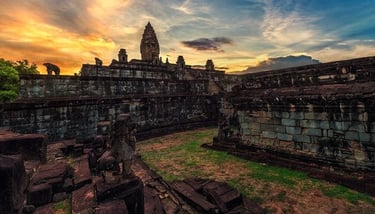
It was at this time that the Gopura of the Royal Palace of Angkor Thom was completed with the sober pyramid of the Phimeanakas at its center. He also erected the temple of Phnom Chiso, some parts of Preah Vihear, and Preah Khan in Kampong Svay District.
King Indravarman I (887-889), a nephew of King Jayavarman II, constructed a vast irrigation system at Lolei and then built the tower of Preah Ko in 879

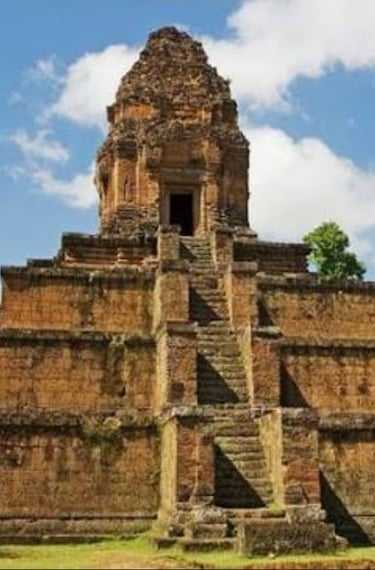
Koh Ker. He erected several majestic monuments. King Rajendravarman (944-968) returned to Angkor in 952 and built the Eastern Mebon and Prè Roup in 961. In 967, the Brahman Yajnavaraha, a high religious dignitary of royal blood, erected the temple of Banteay Srei, about 20 km northeast of the capital. King Jayavarman V (968-1001) founded a new capital around Takeo Temple. In the eleventh century, King Suryavarman I (1002-1050) seized Angkor and founded a glorious dynasty.


King Udayadityavarman II (1050-1066), son of king Suryavarman I, built the mountain temple of Baphuon and Western Baray. King Udayadityavarman’s brother, King Harshavarman III, succeeded him and ruled from 1066 to 1080 when violent strife led to the fall of the dynasty. King Jayavarman VI (1080-1113) continued to build Preah Vihear Mount in Vat Po and Phimai.
King Suryavarman II (1113-1150) extended his power from the coast of the China Sea to the Indian Ocean and built the

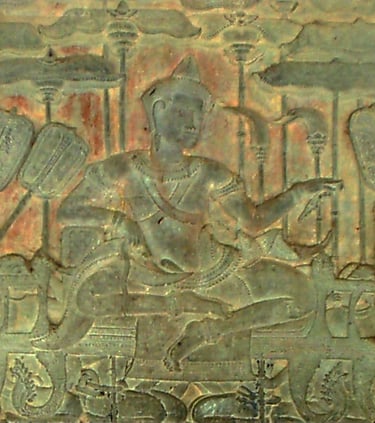
temples of Angkor Wat, Thommanon, Chau Say Tevoda, Preah Palilay, Preah Pithu and Banteay Samrè. After these dazzling achievements, the Khmer civilization began to
decline due to internal strife and an attack by the Chams.
King Udayadityavarman II (1050-1066), son of king Suryavarman I, built the mountain temple of Baphuon and Western Baray. King Udayadityavarman’s brother, King Harshavarman III, succeeded him and ruled from 1066 to 1080 when violent strife led to the fall of the dynasty. King Jayavarman VI (1080-1113) continued to build Preah Vihear Mount in Vat Po and Phimai.
King Suryavarman II (1113-1150) extended his power from the coast of the China Sea to the Indian Ocean and built the temples of Angkor Wat, Thommanon, Chau Say Tevoda, Preah Palilay, Preah Pithu and Banteay Samrè. After these dazzling achievements, the Khmer civilization began to decline due to internal strife and an attack by the Chams
King Jayavarman VII (1181-1220) was the most fascinating personality in Khmer history. He re-established his rule over all of southern Indochina and is best known for his huge building program. He built Ta Prohm (1186) and Preah Khan (1191) as a dedication to his parents.Then he erected Banteay Kdei, Srah Srang, the Terrace of the Leper King, the Terrace of the Elephants, Neak Pean, Ta Saom, Ta Nei, and a few monuments in other parts of the country.t was he who founded his great capital, Angkor Thom and in the center of which, he built the Bayon temple with its two hundred stone faces.
It is understandable that the country was exhausted after these enormous efforts. The decline of the Angkor era began after the death of King Jayavarman VII in the early thirteenth century. Due to Siamese invasion and the limitations of the irrigation system, Khmer power declined so drastically that the king was finally obliged to move to the vicinity of Phnom Penh in 1431. Then, resulting from a series of Siamese and Cham invasions, the country was placed as a French protectorate in 1863.
After regaining Independence in 1953, the country resumed several names:
1. The Kingdom of Cambodia (under the Reachia Niyum Regime from 1953 to 1970)
2. The Khmer Republic (under the Lon Nol Regime from 1970 to 1975)
3. Democratic Kampuchea (under the Pol Pot Genocidal Regime from 1975 to 1979)
4. The People’s Republic of Kampuchea (1979-1989)
5. The State of Cambodia (1989-1993)
6. The Kingdom of Cambodia (1993 until now)
Address
Honorary Consulate of Cambodia, #3, Kengal Hanumanthaiah Rd, Bheemanna Garden, Shanti Nagar, Bengaluru, Karnataka 560027
Contact:
Phone: (+91) 80 4130 6767 ,
E-Mail: hc@cambodiaconsulate.in , yashi.dhariwal@cambodiaconsulate.in
Phone (for appointment schedule): (+91) 73489 22646
(+91) 80 2224 2999 , +91 98 44210133